
What Is an Electric Valve and How Does It Work?
An electric valve is a practical bridge between an electrical command and physical fluid movement. It opens, closes, or adjusts a passage when a controller sends a signal. The signal may come from a thermostat, PLC, pressure sensor, or building-management system. Inside the valve, an electric actuator turns or lifts a stem. That movement changes the position of the valve disc, ball, or plug.
Small details matter. A motorized ball valve may rotate 90 degrees. A solenoid valve may move a plunger within milliseconds. A modulating electric valve can hold a partly open position, helping control water, air, steam, or process chemicals. As process-control author Greg McMillan puts it, “The control valve is the muscle of the process control loop.” The comparison is useful. Sensors provide awareness, controllers make decisions, and the electric valve performs the physical work.
Yet the device is not automatically intelligent. It still needs correct sizing, suitable materials, stable power, and proper installation. A valve that is too large may hunt and wear quickly. A poorly selected actuator may stall under pressure. These failures are ordinary, but costly. Engineers therefore check flow requirements, pressure drop, temperature, duty cycle, enclosure rating, and fail-safe behavior. Standards such as IEC 60534 can support control-valve selection, although field conditions can expose gaps in a neat specification. Understanding how an electric valve works means examining both its electrical signal and its mechanical response. The real test is simple: does it move reliably when the process needs it most?
What Is an Electric Valve?
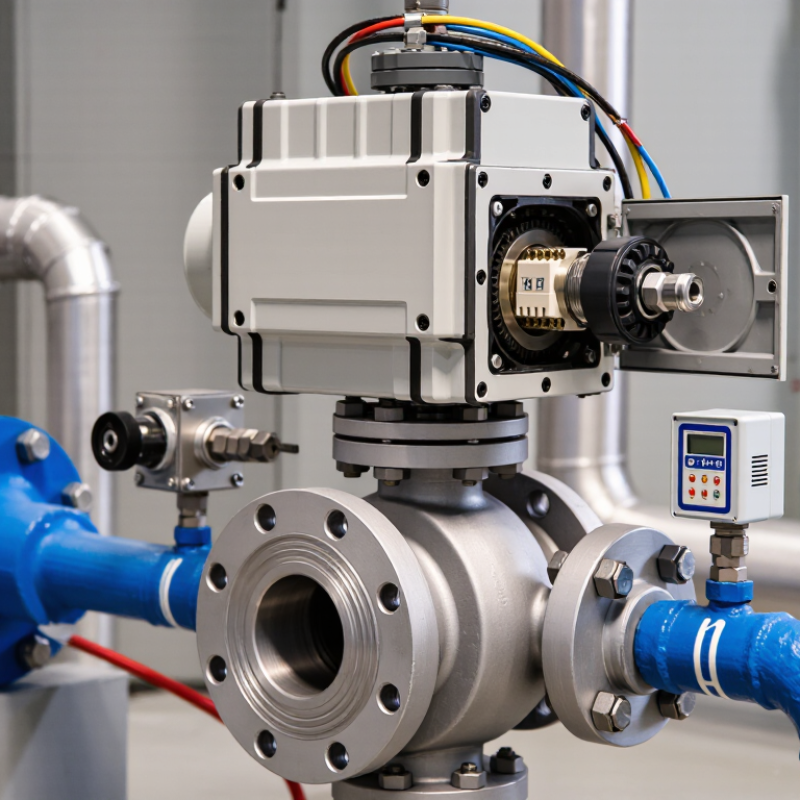
An electric valve controls fluid or gas flow through an electrically powered actuator. The valve body performs the sealing work. The actuator supplies movement. It may rotate a ball or butterfly disc, or move a stem in a globe valve. Unlike a manually operated valve, it can receive signals from sensors, controllers, or automated equipment. That makes repeatable control possible in water treatment, heating systems, process plants, and compressed-air networks.
The term is often misunderstood. An electric valve does not necessarily regulate flow continuously. Some models provide only two positions: open or closed. Others use position feedback for gradual adjustment. A small motor, gearbox, limit switches, and control circuit usually sit above the valve body. During inspection, technicians check wiring, torque, seal condition, and the actual travel position. A valve can sound normal while failing to close fully.
Industry demand is expanding with automation. MarketsandMarkets’ Industrial Valves Market report projects growth from about USD 78 billion in 2023 to nearly USD 94 billion by 2028, at approximately 3.8% annually. The report links this rise to water infrastructure, energy systems, and industrial automation. However, market figures do not prove suitability for every installation. Temperature, pressure, fluid chemistry, response time, and power-loss behavior still require engineering review. That last detail matters. A valve without a defined fail-open or fail-closed position can create avoidable operational risk.
What Is an Electric Valve and How Does It Work?
| Data Dimension | Typical Information | How It Relates to Operation | Practical Considerations |
|---|---|---|---|
| Definition | An electric valve is a fluid-control valve operated by an electric actuator or solenoid. | An electrical command changes the valve position to start, stop, or regulate the flow of a liquid or gas. | The valve body handles the fluid, while the actuator supplies the mechanical movement. |
| Main Components | Valve body, flow-control element, stem or shaft, electric actuator, position feedback, and electrical connections. | The actuator converts electrical energy into rotary or linear mechanical motion. | Seals, bearings, gears, and limit switches may be included depending on the valve design. |
| Common Valve Types | Ball, butterfly, globe, gate, diaphragm, and pinch valves. | Each type uses a different internal element to control flow, such as a ball, disc, plug, gate, or diaphragm. | Ball and butterfly valves are often used for on/off control, while globe valves are commonly used for throttling. |
| Actuator Motion | Quarter-turn, multi-turn, or linear motion. | Quarter-turn actuators rotate a shaft approximately 90 degrees; multi-turn and linear actuators move the valve through a longer travel range. | The actuator must match the valve stem movement and required torque or thrust. |
| Operating Modes | On/off control, modulating control, or proportional positioning. | On/off operation uses two positions, while modulating operation adjusts the valve to intermediate positions. | Proportional control is useful for maintaining flow, pressure, temperature, or liquid level. |
| Typical Control Signals | Switch contacts, relay outputs, analog signals such as 0–10 V or 4–20 mA, and digital communication. | The control signal tells the actuator when to open, close, or move to a target position. | The signal type must be compatible with the controller and actuator electronics. |
| Power Supply | Common supplies include 12 V DC, 24 V DC, 24 V AC, 110–120 V AC, and 220–240 V AC. | Electrical power drives a motor, solenoid coil, or internal electronic actuator circuit. | The voltage, frequency, current, and duty cycle must match the actuator specifications. |
| Flow-Control Function | Isolation, diversion, mixing, flow regulation, pressure control, or emergency shutoff. | Changing the opening area alters the volume and direction of fluid passing through the system. | Valve sizing should consider flow rate, pressure drop, fluid properties, and required control accuracy. |
| Fail-Safe Behavior | Fail-open, fail-closed, fail-in-place, or manual override operation. | Some actuators use a spring or backup power source to move the valve to a predetermined safety position. | The correct failure position depends on the process risk and whether continued or stopped flow is safer. |
| Response Time | Often ranges from fractions of a second for small solenoid valves to several seconds or minutes for larger motorized valves. | Response time depends on actuator size, valve travel, load, control method, and fluid pressure. | Fast-closing valves may create water hammer or pressure surges in liquid systems. |
| Operating Temperature | The allowable range depends on the valve materials, seals, actuator enclosure, and fluid temperature. | Temperature affects sealing performance, lubricant behavior, electronics, and actuator service life. | The fluid temperature and surrounding ambient temperature should both be checked before selection. |
| Pressure and Flow Rating | Specified by the valve design, size, material, pressure class, and flow coefficient. | The valve must withstand system pressure while providing the required flow at an acceptable pressure drop. | Never select a valve using pipe size alone; pressure, flow rate, and fluid type are also required. |
| Compatible Media | Water, air, steam, oils, gases, chemicals, and other process fluids, depending on construction materials. | The body, trim, diaphragm, and seals must resist corrosion, erosion, swelling, and temperature damage. | Material compatibility should be verified for concentration, temperature, pressure, and fluid cleanliness. |
| Position Feedback | Limit switches, potentiometers, encoders, auxiliary contacts, or integrated position transmitters. | Feedback confirms whether the valve is open, closed, or at an intermediate position. | Feedback improves monitoring, diagnostics, sequencing, and process safety. |
| Manual Override | A handwheel, lever, clutch, or emergency operating mechanism may be provided. | Manual operation allows the valve to be positioned during power loss, commissioning, or maintenance. | Manual overrides should be used according to the actuator instructions to avoid mechanical damage. |
| Advantages | Remote operation, precise positioning, repeatable control, automation compatibility, and reduced manual labor. | Electrical signals allow the valve to respond to sensors, programmable controllers, and building or process management systems. | Electric actuation is particularly useful where compressed air or hydraulic power is unavailable. |
| Limitations | Dependence on electrical power, possible motor or gear wear, slower movement in some designs, and sensitivity to unsuitable environments. | A power interruption or incorrect control signal can prevent the valve from reaching the required position. | Outdoor, wet, dusty, explosive, or corrosive locations require an appropriately rated enclosure and installation method. |
| Typical Applications | Water treatment, heating and cooling systems, irrigation, process equipment, compressed-air systems, fuel systems, and industrial automation. | The valve automatically controls utilities or process fluids based on timers, sensors, or programmed sequences. | Application selection should account for hygiene, hazardous-area requirements, cycling frequency, and maintenance access. |
| Basic Maintenance | Inspect wiring, seals, mounting, corrosion, leakage, actuator noise, travel limits, and position feedback. | Regular inspection helps ensure that the actuator can move the valve fully and that the valve seals correctly. | Maintenance intervals depend on cycle frequency, fluid cleanliness, temperature, vibration, and operating conditions. |
Related Posts
-
China Best Electric Valve Suppliers for Global Buyers
-
Top 10 Electric Valve Benefits for Industrial Applications You Should Know
-
Top 10 Electric Valve Types for Your Next Project?
-
Top 5 Tips for Choosing the Right Electric Valve for Your Needs?
-
Discover Top Quality Electric Valves from Leading Manufacturers in China
-

7 Effective Strategies for Choosing the Right Electric Valve