
7 Tips for Choosing Non Woven Wet Wipes Suppliers

Choosing a supplier for Non Woven Wet Wipes is not just a price comparison. The right partner can affect softness, absorbency, packaging quality, and delivery consistency. A sample may feel smooth in your hand, yet perform differently after storage or repeated use. Small details matter.

This guide presents seven practical tips for evaluating suppliers, from checking material specifications to reviewing production controls and communication. Ask for clear information about fiber composition, wipe dimensions, lotion options, packaging, and quality checks. Where possible, compare samples under the same conditions and record what you notice. A simple test can reveal differences in texture or lint, though it cannot replace proper product testing.

Look beyond polished brochures. Confirm that the supplier can explain how it manages batch consistency, handles defects, and responds when orders change. Request relevant documentation, and verify that claims match the products and markets you serve. Details vary by application, so one supplier may not suit every brand. Even a careful review has limits; samples represent only a snapshot of production. Keep that in mind. These checks can help you make a more informed decision and build a supplier relationship based on evidence, clear expectations, and steady communication.
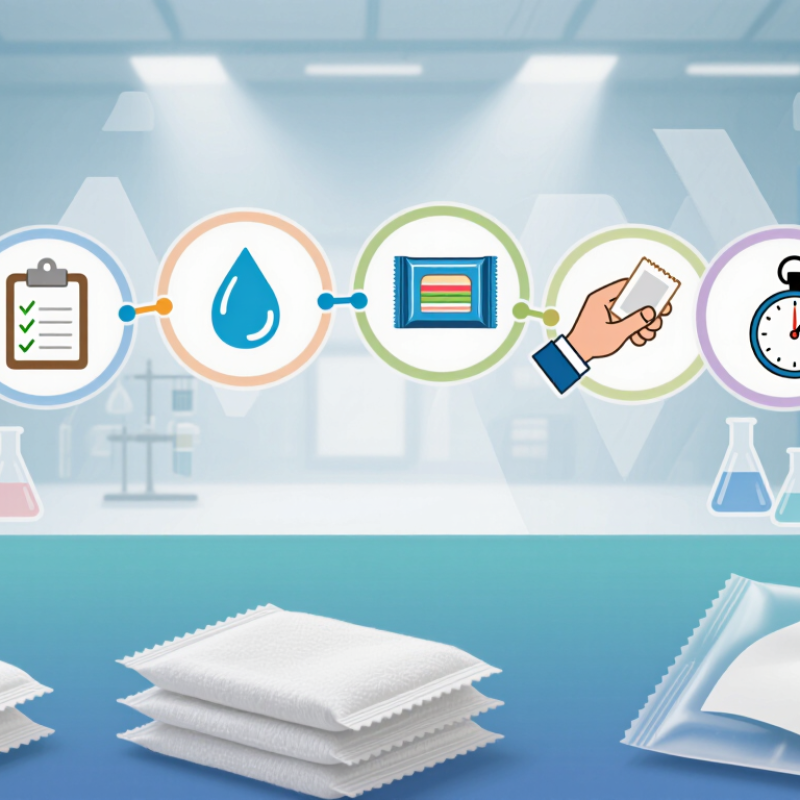
7 Tips for Choosing Non Woven Wet Wipes Suppliers

Set Wipe Requirements: Measure Nonwoven Basis Weight Under ISO 9073-1

When comparing nonwoven wet wipe suppliers, ask how they measure basis weight, not just what number appears on a specification sheet. ISO 9073-1 describes a method for determining the mass per unit area of nonwoven fabric. In practice, a measured specimen is weighed and its area is used to calculate grams per square metre. Small differences in cutting, conditioning, or scale precision can affect results. Ask the supplier to share the test method, sample size, and recent inspection records.

Then connect the number to the wipe’s intended use. A heavier fabric may feel more substantial, but basis weight alone does not prove strength, softness, or absorbency. Check samples for lint, wet handling, and coverage, and compare them under the same conditions. Ask whether reported values represent an average and how much variation is allowed between rolls. Details matter. One awkward gap in many specifications is that they list a target weight without explaining tolerance. That deserves a follow-up. Keep your own retained sample, too; it gives both sides a practical reference when later deliveries feel different.

Set Wipe Requirements: Measure Nonwoven Basis Weight Under ISO 9073-1

Illustrative basis-weight readings for four sample nonwoven materials. ISO 9073-1 specifies a method for determining mass per unit area; it does not prescribe a universal target weight for wet wipes.

Use the agreed product specification to assess whether a supplier’s material meets your requirements. The values shown are illustrative, not test results or recommended limits.

Check Strength and Uniformity Using ISO 9073-3 Test Methods

When qualifying a nonwoven wet wipes supplier, ask for tensile test reports based on ISO 9073-3. This ISO method measures breaking force and elongation under tensile loading. Check both machine direction and cross direction: a sheet may tear easily across its width while appearing strong along the roll. Look for stated specimen dimensions, conditioning, test speed, and individual results—not only a single average. Details matter.

Uniformity needs repeated measurements. Request results from several positions across the web and from multiple production lots, then compare the spread as well as the mean. A narrow spread can indicate steadier converting performance, though it does not guarantee every wipe will behave identically. Ask the supplier to explain outliers, rather than quietly removing them. Small differences can matter.

ISO 9073-3 evaluates tensile properties of nonwovens; it does not establish a universal pass level for every wipe. Set acceptance limits around your product’s converting and use requirements. Also request wet-state testing under a documented, consistent procedure, since dry tensile results do not predict performance after saturation. Feel the sample, too. A neat report is useful, but a wipe that stretches unevenly or leaves weak edges deserves another look.

Assess Supplier Quality Systems Against ISO 9001:2015 Requirements

When evaluating a non woven wet wipes supplier, ask how its quality system aligns with ISO 9001:2015. A certificate can be useful, but it is not proof that every production detail is controlled. Check the certificate’s scope, issuing body, and validity dates. Does it cover the site and activities that will make your wipes?

Look beyond the paperwork. Request procedures for incoming material checks, production monitoring, and release of finished goods. Ask how the supplier records changes to fabric, lotion, or packaging specifications. Sample records should be clear and traceable from a material lot to a finished batch. Small details matter. Check whether measuring equipment is calibrated, and whether staff training records match their assigned tasks. A tidy document set is reassuring, but it can still hide weak habits on the production floor.

Ask how nonconforming batches are contained and how corrective actions are verified. A useful answer includes the cause, action taken, and evidence that the issue did not recur. Vague promises deserve a follow-up question. During a site visit, compare written procedures with actual work at the line. Gaps are possible, even in a certified system. Note them, agree on evidence and timelines, and review progress before placing a larger order. ISO 9001:2015 supports consistent management; it does not replace product-specific testing or your own supplier checks.

Verify Biodegradability Claims: OECD 301 Requires 60% in 28 Days

When comparing non-woven wet wipe suppliers, ask for the full biodegradability test report, not just a leaf-shaped symbol or a sales claim. OECD 301 methods assess ready biodegradability under controlled laboratory conditions. A common pass threshold is 60% biodegradation within 28 days, measured against the method’s criteria. Details matter.

Check what was tested. A report for one fiber or lotion ingredient does not automatically prove that the finished wipe is biodegradable. Ask for the sample description, test method, laboratory, dates, and measured results. Make sure the material in the report matches the product you plan to buy, including its fiber blend and relevant additives. Small differences can matter.

Look for the test curve, not only the final percentage. OECD 301 methods include different procedures, so results should be read in context. Ask the supplier to explain any terms you cannot verify. That is reasonable. I have seen tidy summaries that leave out useful details, and comparing reports can still feel awkward. A careful supplier should answer specific questions without promising that a laboratory result guarantees breakdown in every environment. In practice, the report is evidence about tested conditions, not a universal disposal instruction.

Confirm EU Plastic-Wipe Labels Meet Single-Use Plastics Rules

When evaluating non woven wet wipes suppliers, ask whether the product contains plastic and whether EU marking rules apply. The rules cover certain wet wipes intended for personal care or domestic use when they contain plastic. Not every wipe has the same labeling obligation. Details matter.

Request the supplier’s material specification, packaging artwork, and written confirmation of the intended market. Check that required marking is clear, durable, and visible on the sales packaging. It should explain that the product contains plastic, show disposal guidance, and communicate the environmental impact of littering. A tiny symbol near a sealed edge may technically be present, yet still be hard for shoppers to notice. Ask for a packaging proof before production. Then check the final printed sample, not only a digital file.

Keep records of the supplier’s statements and the versions of labels you approve. If the fiber blend or packaging changes, review the artwork again. Do not rely on a broad claim such as “plastic-free” without checking the full composition and applicable requirements. That claim can be easy to misunderstand. I have seen teams focus on the wipe sheet and overlook plastic in other components; it is a useful reminder to check the complete product. For uncertain cases, seek qualified regulatory advice for the destination market.

7 Tips for Choosing Non Woven Wet Wipes Suppliers - Confirm EU Plastic-Wipe Labels Meet Single-Use Plastics Rules

Tip What to Check Evidence to Request Why It Matters Relevant Reference
1. Verify the wipe substrate composition Ask whether the non-woven substrate contains plastic polymers, such as polyester or polypropylene, and distinguish these from cellulosic fibres such as viscose or lyocell. Written fibre-composition specification for each product, including percentages and any coatings or binders. EU single-use-plastics labelling rules cover wet wipes containing plastic. “Non-woven” describes a fabric structure and does not, by itself, mean plastic-free. Directive (EU) 2019/904, Article 7 and Annex, Part D
2. Confirm whether the EU label requirement applies Determine whether the product is a wet wipe intended for personal care or domestic use and whether it contains plastic. Product classification, intended-use description, and documented assessment of the applicable EU labelling requirement. Article 7 of Directive (EU) 2019/904 sets marking requirements for covered wet wipes containing plastic when placed on the market in EU Member States. Directive (EU) 2019/904
3. Check the harmonised label artwork For products in scope, check that the packaging uses the applicable harmonised marking, including the prescribed wording and graphic layout. Final pack artwork and a review against the applicable EU implementing regulation and its annexes. The format and specifications for the wet-wipe marking are set out in Commission Implementing Regulation (EU) 2020/2151; a custom symbol should not be treated as a substitute. Commission Implementing Regulation (EU) 2020/2151
4. Check language and placement for each market Confirm that the required text is provided in the official language or languages determined by the Member State where the product is marketed, and that the marking is placed as required. Country-specific packaging versions, language review, and print-ready proofs showing label size and position. Labelling details can affect packaging approval across different EU markets. Validate the current requirements for each destination country. Implementing Regulation (EU) 2020/2151, including its annexes
5. Request substantiation for environmental claims Review claims such as “plastic-free,” “biodegradable,” “compostable,” or “flushable” against the product’s actual composition and the conditions or standards cited. Test reports or technical documentation that identify the tested product, method, conditions, and limitations of each claim. Claims should be specific and supported. A claim does not replace a legally required marking where the product falls within the scope of the EU rules. Directive (EU) 2019/904
6. Assess quality controls and traceability Check how the supplier controls fibre composition, lotion application, dimensions, packaging, and batch consistency. Product specifications, batch records, inspection procedures, change-control process, and complaint or recall procedure. Documented controls help buyers confirm that delivered products match approved specifications and packaging artwork. Review the supplier’s product and quality documentation for the specific item being sourced.
7. Confirm change notification and market documentation Agree that changes to substrate, formulation, manufacturing site, or packaging will be communicated before implementation. Written change-notification terms, current technical file, and an agreed process for checking revised EU-market artwork. A change in materials or packaging may affect product claims, label applicability, or the accuracy of previously approved documentation. Implementing Regulation (EU) 2020/2151

Note: This table is a supplier-screening aid, not legal advice. Confirm the current EU and Member State requirements for each product and destination market before approving or placing packaging on the market.